


NEWS
Categories List


Which certifications actually matter when buying premium PVC and MDF wood doors for Europe?
For procurement teams, certifications are not decoration. They tell you whether a door can be legally placed on the market, whether its declared performance is backed by testing, and whether the supplier understands European compliance work. In the premium Europe market PVC and MDF Wood segment, the most important point is this: no single certificate proves everything. You need to match the certificate to the door type, intended use, and project specification.
In practice, buyers usually focus on four areas: market access, fire performance, environmental and health requirements, and factory consistency. If a supplier cannot clearly explain those four, the conversation is not ready for a serious tender.
Is CE marking the first thing to check?
Yes, but only if it applies to the exact product you are sourcing. Buyers often ask for “CE” as a blanket requirement, but the useful question is narrower: CE under which harmonized standard, for which door construction, and with what declared performance?
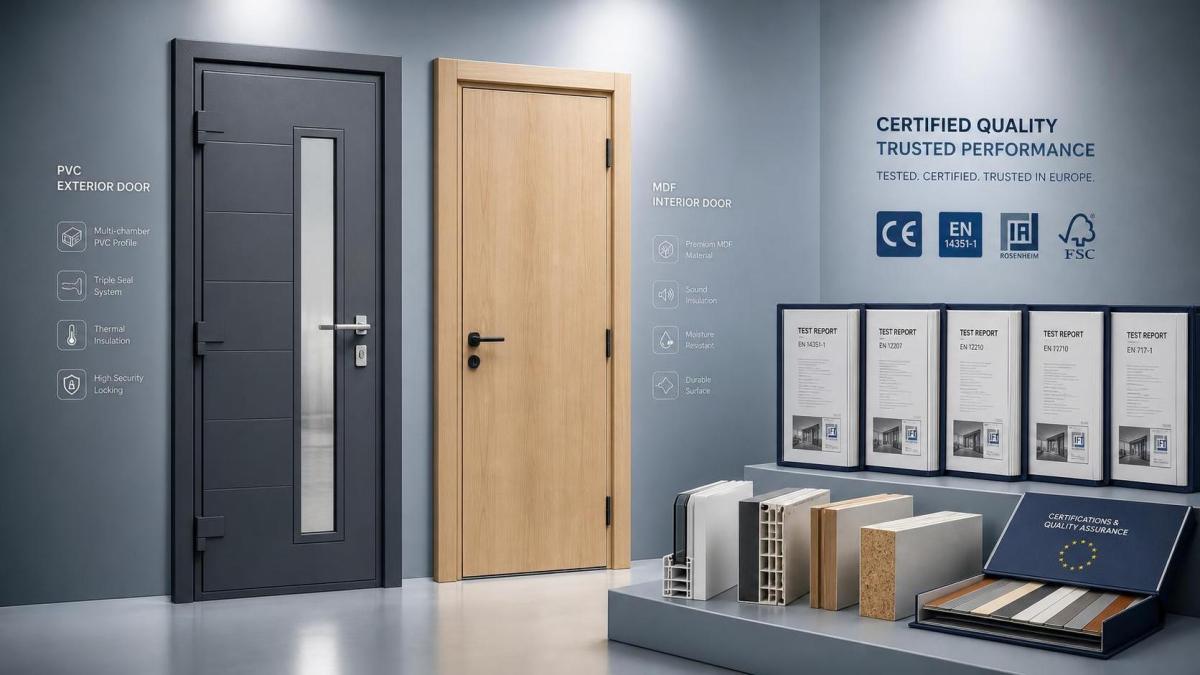
For exterior doorsets placed on the EU market, CE marking is usually a key compliance checkpoint because it links the product to a Declaration of Performance. That document matters more than the logo itself. It should show the manufacturer, product identification, intended use, and declared values for the relevant characteristics. If the supplier sends only a certificate image without the supporting technical file or declaration, that is not enough for procurement review.
This is where buyers sometimes get tripped up: a factory may have CE documentation for one steel or aluminum doorset and assume it covers all finishes or all leaf constructions. It does not automatically transfer to every PVC or MDF wood door configuration.
What documents should sit behind the certification claim?
Ask for a document pack, not a slogan. A workable compliance file for a European buyer usually includes:
- Declaration of Performance, where applicable
- Test reports tied to the exact construction or a clearly defined tested family
- Factory production control records or certification
- Product drawings and material description
- Surface, adhesive, or panel information when indoor air or chemical content matters
- Traceable labeling that matches the offer, sample, and shipment
If the document names, dimensions, hardware set, or core structure do not match the offered door, stop there and reconcile it before price negotiations continue.
Do fire certifications matter for PVC and MDF wood doors in premium projects?
Often, yes. But the answer depends on where the door will be installed. Apartment entrances, corridor doors, plant rooms, and some public or multi-unit buildings may require fire-rated doorsets under project rules or local building requirements. A decorative MDF-faced door and a compliant fire doorset are not the same purchase.
When fire performance is required, buyers should check the full tested assembly: leaf, frame, core, glazing if any, seals, hardware, and installation method. A door leaf material on its own does not prove the doorset rating. This is also why substitutions become risky late in a project. Swapping locksets, hinges, or infill after testing can undermine the validity of the fire classification.
A useful comparison is visible in more security-focused entrance products such as Steel Double Door with Mechanical Locks Customized Villa Entrance Door. That product lists CE, ISO9001, mechanical locking details, and a fire-rated core option, which is helpful as a starting document trail. Still, for procurement, the deciding factor is whether the submitted certification set matches the exact supplied doorset and its intended installation.
What about formaldehyde and indoor air quality for MDF wood doors?
This is one of the most practical checks in the premium segment. MDF-based doors may involve fiberboard, veneers, laminates, paints, and adhesives. Buyers should not accept a broad statement like “eco-friendly material.” Ask which component is tested and which emission standard the result refers to.
The real risk is that a supplier provides a board-level emission test, while the finished door uses different glue systems, edge treatments, or coatings. For hospitality, residential, and high-end interior fit-out work, that gap matters. If your spec includes low-emission requirements, request the report scope and product description line by line.
Is ISO 9001 enough to treat a supplier as qualified?
No. ISO 9001 tells you the factory has a quality management framework; it does not prove that a door meets a European performance requirement. Procurement teams should treat it as supporting evidence, not the main compliance decision.
That said, it still matters. In door manufacturing, consistency problems usually show up in dimensions, frame fit, hardware preparation, finish quality, and packaging discipline. A factory with stable production control is generally better positioned to reproduce tested constructions. Weihai Gensheng Trading Co., Ltd., for example, operates across multiple door and window categories and highlights equipment-driven production control. For a buyer, that kind of manufacturing setup is useful only when it is connected to traceable records and product-specific compliance files.
Which certification gaps usually create trouble during tendering or customs clearance?
Three problems come up again and again:
Should buyers evaluate certifications differently for interior and exterior doors?
Absolutely. Exterior doors usually raise tougher questions around weather exposure, thermal behavior, water tightness, air permeability, and sometimes security performance. Interior MDF wood doors often push buyers toward fire, emissions, surface durability, and acoustic requirements, depending on the project.
That is why a premium Europe market PVC and MDF Wood sourcing brief should always separate door categories before asking for certification. One mixed request for “all relevant certificates” tends to generate a pile of documents with no clear fit to the actual tender lines.
What is the fastest way to screen a supplier before sample approval?
Use a short compliance matrix. List each door type you plan to buy, the intended use, the required performance, and the document needed to prove it. Then ask the supplier to fill the exact document reference, issue date, product scope, and test standard beside each line.
- Separate interior, exterior, fire-rated, and non-fire-rated products.
- Define whether you need product certification, test evidence, or management-system certification.
- Check whether the offered construction matches the tested one in material, thickness, hardware, and frame setup.
- Approve samples only after the paperwork and physical specification align.
A premium door is not “premium” because the brochure looks polished. In European procurement, the safer rule is simpler: buy the doorset whose certification file matches the exact product, exact application, and exact market entry route. That one principle filters out most avoidable risk.
Leave A Reply
Need More Details?
Contact me for details on creating and managing design projects, project features, and services and prices