


Categories List
Spring Doors for Commercial Entrances: Selecting Closers for Traffic and Door Weight
A commercial entrance can look straightforward on a drawing: a door leaf, a frame, glazing, hardware, and a closer. In daily use, however, the closer often decides whether that entrance feels controlled or constantly troublesome. A door that slams after every delivery, drifts open in a crosswind, or requires too much force to open will quickly become a maintenance issue—and sometimes an access or safety concern.
When sourcing Spring Doors for a commercial project, buyers should avoid selecting hardware by appearance alone. The practical question is not simply whether a spring closer can shut the door. It is whether it can repeatedly control that particular door leaf, at that opening, under the expected traffic pattern. Door weight, width, material, latch type, wind exposure, and frequency of use all affect the answer.
This matters especially in projects that combine aluminum entrance systems with wooden interior doors, folding partitions, or mixed-material door packages. A closer that behaves well on a light internal timber door may be entirely unsuitable for a wide glazed aluminum entrance. Treating all spring-loaded doors as the same category is one of the more expensive procurement shortcuts.
Start with the actual door leaf, not the hardware catalog
The first step is to establish the operating load of the door. Weight is important, but width deserves equal attention. A wide door creates more leverage at the hinge or pivot side, so even a moderately weighted leaf can place substantial demand on the closing mechanism. Tall doors, doors with large glass panels, and doors carrying pull handles or access-control hardware may also behave differently from a plain solid leaf.
For procurement purposes, request the finished door weight rather than relying only on material descriptions. “Aluminum door” can refer to a narrow-profile single-glazed leaf or a much heavier insulated, reinforced, or laminated-glass assembly. The same is true for timber. A lightweight hollow-core internal door and a solid, moisture-resistant wood door should not be assigned the same closer without checking the manufacturer’s permitted door weight and width range.
It is also worth confirming the hinge or pivot arrangement early. Spring hinges, concealed closers, overhead hydraulic closers, and floor springs do not transfer force in the same way. The choice affects not only closing performance but also frame preparation, glass cut-outs, floor construction, and later service access.
Traffic volume changes the closer decision
A low-use office side door and a busy retail entrance may have identical dimensions, yet they need different hardware thinking. At a high-traffic opening, the closer is repeatedly asked to absorb manual force, recover from partial openings, overcome latch resistance, and return the leaf to the closed position without a harsh impact. A basic spring mechanism may be adequate for a lightly used internal swing door, but it can become inconsistent or uncomfortable at a continuously used entrance.
Hydraulic control is often preferred where the closing speed needs adjustment. It allows the supplier or installer to tune the sweep and final latching action separately, within the limitations of the hardware. That final closing stage matters more than it appears. If it is too weak, the latch may not engage; too aggressive, and the door can strike the frame, disturb nearby occupants, and gradually damage seals or hardware.
For very busy entrances, buyers should also ask a practical question: what happens when people do not use the door gently? Staff pushing carts, visitors carrying bags, cleaners moving equipment, and delivery teams often use a door differently from its intended pedestrian flow. The closer should be selected for real use, not ideal use.
Match the closer type to the entrance condition
Spring hinges are compact and visually simple, making them a reasonable choice for some lighter swing doors. Their limitations become apparent when a door requires reliable speed control, strong latching action, or resistance to changing pressure conditions. They are not automatically the economical choice if frequent adjustment or replacement follows.
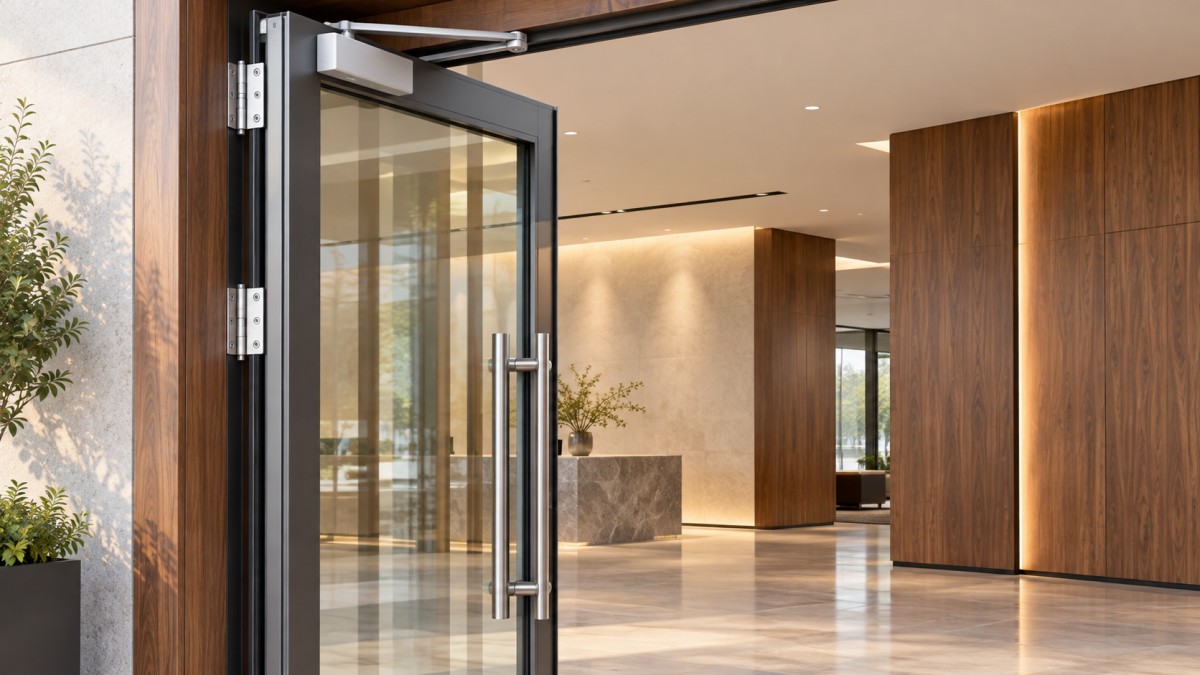
Overhead closers are commonly selected when adjustability and service access are priorities. They can suit aluminum or timber doors, provided the frame and door construction have suitable fixing points. Buyers should check whether a closer body will interfere with transoms, glazing details, signage, or concealed wiring. A hardware schedule may look complete while still missing this coordination detail.
Floor springs are often considered for heavier doors, glass doors, or entrance designs where a more discreet appearance is desired. They can provide a clean visual result, but their installation depends on the floor build-up, drainage considerations, pivot alignment, and waterproofing details. Replacing a floor spring after finishes are complete is rarely a minor job. It is a decision best made with input from the door fabricator, contractor, and hardware supplier before the slab and threshold details are fixed.
Do not ignore wind, air pressure, and latch resistance
Exterior entrances are affected by conditions that do not appear in a showroom test. Wind can catch a door during opening or closing. Pressure differences between an air-conditioned interior and an exterior corridor can make a door feel unexpectedly heavy. Weather seals improve performance at the perimeter, but they also add resistance. A closer that is barely sufficient in a calm factory test may struggle once seals, thresholds, and locks are fully installed.
This is why buyers should review the complete door set: leaf, frame, hinges or pivots, lock, latch, seals, threshold, handle, and access-control devices. A closer cannot compensate for poor alignment, distorted frames, excessive seal compression, or a latch that requires force to engage. If a sample door needs to be slammed to latch, the answer is not automatically “use a stronger closer.” First determine what is creating the resistance.
Material compatibility is more than an aesthetic issue
Aluminum profiles need sufficient reinforcement and fixing zones for the selected closer. Thin sections may require a dedicated backing plate or a revised hardware location. Timber doors require attention to screw holding, edge distances, moisture movement, and the weight distribution of the leaf. For wood-aluminum assemblies, the closer should be specified against the final composite construction rather than against only one visible face material.
This coordination becomes useful when a project includes both public-facing entrances and quieter interior spaces. For example, a customizable wooden door package such as High Quality Wooden Wood Door Custom Size Interior Bedroom Door Wholesale may be considered for interior bedroom or residential-style room applications where color, grain, acoustic comfort, moisture resistance, and door dimensions are important. Those features should be evaluated separately from the heavy-duty closer requirements of a commercial external entrance. A fire-rated, water-tight, or soundproof door claim should always be confirmed against the required tested assembly and local project requirements.
Questions that prevent procurement mistakes
Before approving Spring Doors and closers, the purchasing team should obtain a clear submittal covering the finished leaf weight, leaf width and height, opening direction, hinge or pivot type, expected traffic level, closer mounting method, hold-open needs, and lock or access-control arrangement. For external doors, wind exposure and weather sealing should be included. These are basic details, but omissions here often lead to late substitutions.
Ask who will adjust the closer after installation and whether replacement parts are available in the project market. Closers are wear items. A supplier may provide a well-made door, but long-term performance still depends on correct installation, periodic adjustment, and practical service access. In multi-door projects, standardizing compatible closer families can simplify future maintenance, as long as each opening still receives the correct power range.
Weihai Gensheng Trading Co., Ltd. works across aluminum casement, folding and sliding doors, aluminum louvers, spring doors, handrails, wooden doors, and wood-aluminum window and door systems. For buyers assembling a mixed package, that broader system view is useful: door fabrication, profile design, hardware fixing conditions, and production accuracy should be reviewed together rather than purchased as disconnected items. Advanced production equipment and window software can support consistency, but the final specification still needs to reflect the actual opening conditions.
A closer should feel controlled, not powerful
The best commercial door closer is rarely the strongest option on a catalog page. It is the one that opens with acceptable effort, closes reliably, latches without slamming, suits the door’s weight and geometry, and can be maintained without disrupting the building. Where information is incomplete, request a door-and-hardware schedule before placing the order. That small step is usually cheaper than correcting a closer choice after the entrance is already in service.
Leave A Reply
Need More Details?
Contact me for details on creating and managing design projects, project features, and services and prices