


NEWS
Categories List
Recent Posts


Start with the failure mode, not the finish sample
When buyers compare Premium Europe Market PVC and MDF Wood doors, the usual mistake is to judge them from a showroom surface. Moisture stability problems rarely begin on day one. They show up later as edge swelling, face bubbling, joint movement, lock area deformation, or a door leaf that no longer closes cleanly after seasonal humidity swings.
For decision-makers sourcing interior door programs, the practical question is simple: which parts of the construction are most likely to move when moisture changes, and what evidence does the supplier provide before shipment? That is where experienced manufacturers make a difference. In facilities using advanced German equipment and production software, dimensional consistency and process control are usually easier to manage, but the buyer still needs a working checklist.
Use the checks below in the same order you would review a quotation, a sample, and a pre-production file.
Check what the door is actually made of
“PVC and MDF wood door” can describe very different products. One may be an MDF-based leaf with PVC lamination. Another may combine solid wood framing, MDF panels, and a finished PVC surface. Moisture behavior changes with each layer.
- Ask for the door leaf build-up: face material, edge treatment, core or filler, internal frame, and surface finish.
- Pay attention to mixed constructions. Solid wood, MDF, and PVC can work well together, but only when the movement of each layer is accounted for in pressing and bonding.
- Do not treat “finished” as a technical answer. A neat surface tells you nothing about moisture resistance at the edge, lock cutout, hinge recess, or top and bottom ends.
If the supplier cannot describe the structure clearly, you are already carrying avoidable risk into production.
Look hard at edge sealing and cut areas
In real projects, moisture trouble often starts at the edges, not the face. The flat panel may look stable, but the edge banding, wrapping line, or trimmed corner becomes the entry point.
Ask how all six sides are protected. Then check the hardware preparation zones separately. A door can have a well-laminated face and still fail around the latch or bottom edge if those areas are exposed or poorly finished after machining.
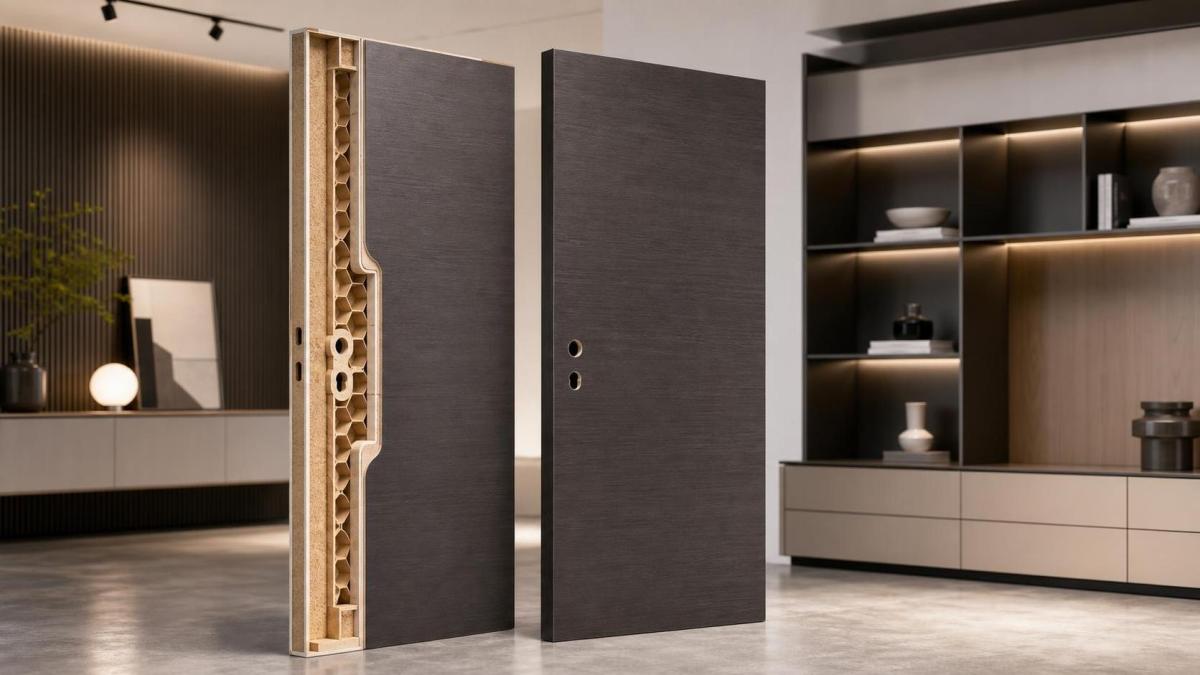
This is also where product details matter more than brochure language. For example, a specification such as Goldea Wholesale Price China Factory UL 30mins/60mins Fire Rated Swing Wooden Interior MDF Solid Wood PVC Entrance Main Door Design is worth reviewing not just for fire rating, but for the actual material combination, finished surface, and filler options such as semi-hollow strips or honeycomb, because those choices influence both weight balance and moisture response in service.
Separate core stability from surface stability
Buyers often talk about PVC lamination as if it solves the whole moisture issue. It does not. PVC helps protect the surface, but the substrate still determines whether the leaf stays flat.
A useful review point is whether the door design is face-driven or structure-driven. If the leaf depends on the surface skin to hide internal movement, you may see delayed warping once the door enters a heated apartment in winter or a humid coastal environment in summer. If the structure is balanced and properly pressed, the finish is working as protection rather than compensation.
Ask for the manufacturing sequence, not just the dimensions
A door leaf sized to max 2300 x 1100 x 40 mm can be perfectly workable, but larger leaves generally put more stress on moisture stability. The key question is how the supplier controls the sequence: conditioning of raw materials, pressing, trimming, machining, finishing, curing, and packing.
This matters because some defects are process defects disguised as material defects. MDF gets blamed for swelling when the real issue was uncontrolled storage before lamination. PVC gets blamed for peeling when the root cause was poor pressing or rushed post-processing. Ask for the order of operations used on your exact door type, especially if the opening direction, handle position, or hardware prep is customized.
Match the door to the actual interior environment
Not all “interior” spaces behave the same way. Entrance-side interior doors, apartment corridors, heated bedrooms, and units near kitchens or semi-exposed lobbies can see very different humidity patterns. Premium Europe Market PVC and MDF Wood door selection should be tied to the installation condition, not just the room label.
- If the door sits between two environments with different humidity or temperature, ask about leaf balance and edge protection first.
- For entrance-related positions, check whether the specification is still treated as interior furniture grade or as a higher-demand assembly.
- If fire-rated construction is required, review whether the moisture-control details remain consistent with the rated build-up rather than assuming rating alone solves dimensional performance.
Read certificates for scope, not for comfort
A UL mark or fire-rated claim addresses a specific scope. It does not automatically tell you how the product will behave under moisture cycling, and it does not cover every size, filler, facing, or hardware change unless those are part of the approved construction.
So when a supplier offers a UL 30 or 60 minute door, check the exact rated configuration against the one you are buying: leaf structure, dimensions, swing type, and application. That protects you in two ways. You avoid compliance drift, and you avoid changing the build-up in a way that weakens moisture stability.
Do not ignore packaging and lead time
Moisture stability can be lost after production if packaging is weak or storage is careless. This is where buyers sometimes create their own problems by compressing timelines. A production pace such as about 25 days per 500 sets or high daily output may be commercially attractive, but you still need to know how finished leaves are protected before loading and how long they rest after finishing.
Doors that leave the factory too early, or sit in damp warehousing before installation, may arrive looking fine and move later. That becomes a claim argument nobody wants.
A short decision sequence that works
- Confirm the exact door construction, including substrate, filler, frame, and finish.
- Review edge sealing and all machined exposure points.
- Check whether the door size and application increase movement risk.
- Match certificates to the precise build-up being purchased.
- Verify process sequence, packing method, and storage conditions before shipment.
That order keeps the discussion technical and commercial at the same time. It also helps you compare suppliers on something more useful than a polished sample board. In this category, moisture stability is not one feature. It is the result of material choice, process control, protected detailing, and using the right door in the right indoor condition.
Leave A Reply
Need More Details?
Contact me for details on creating and managing design projects, project features, and services and prices