


NEWS
Categories List
What actually makes Premium Europe Market PVC and MDF wood doors expensive?
For procurement teams, door pricing rarely comes down to the panel alone. When buyers compare Premium Europe Market PVC and MDF Wood door sourcing options, the biggest cost differences usually come from five areas: material grade, structural build, finishing quality, compliance requirements, and delivery complexity. A door that looks similar in a photo can land at a very different unit cost once you account for core material density, edge banding method, hardware preparation, surface treatment, and packaging for export.
That is why the low quote is often not the low total cost. If a supplier uses lower-density MDF, thinner skins, inconsistent lamination, or basic wrapping that cannot protect the product in transit, the savings may disappear through claims, replacements, delayed installation, or site rework.
Is raw material choice the biggest cost driver?
In many cases, yes. For MDF and PVC-related door programs, material selection has a direct effect on price and a long tail effect on quality consistency.
Buyers should look beyond the words “MDF” or “PVC finish” and check what is actually being supplied. A higher quote may reflect better board stability, stronger internal construction, or improved moisture resistance. In the Europe-facing market, these details matter because interior performance, appearance retention, and installation accuracy are watched closely, especially in hotels, apartments, schools, and healthcare environments.
- MDF, HDF, plywood, composite, and solid wood components do not carry the same cost or performance profile.
- Surface choice matters too: laminated finishes and painted finishes create different labor, reject-rate, and maintenance implications.
- Sound insulation, fire resistance, and moisture resistance often require upgraded internal materials rather than cosmetic changes.
If the application involves frequent use or stricter building expectations, buyers should request a full build-up description instead of approving by appearance sample alone.
Why do two MDF wood doors with similar dimensions come with very different quotes?
Because dimensions are only one line in the cost sheet. The hidden variables are usually where the money goes. A 2100 x 900 door can be basic, or it can be engineered for sound insulation, fireproof use, moisture control, seamless edge finishing, and repeated commercial traffic.
For example, a product such as Hot Sale Modern Interior Entrance Door Fireproof Wooden Room Door Sound Insulated MDF Timber Solid Wood Doors for Hotel naturally carries cost inputs tied to its function. If a buyer specifies fireproof, sound insulated, laminated or painted finish, customized size, and project color matching from RAL code, pricing will not track with a standard residential interior slab.
This is where many sourcing mistakes start: one RFQ asks for “MDF wooden door,” while another supplier prices a much simpler build than the project really needs.
How much does customization push up sourcing cost?
Usually more than first-time buyers expect. Customized-to-measure orders increase not only production effort but also planning cost, material yield loss, packaging variation, and inspection time. If each opening has different dimensions or hardware prep, the factory loses some of the efficiency that keeps standard products affordable.
Customization becomes more expensive when it includes:
- Non-standard sizes across the same order
- Multiple finish colors in small quantities
- Special core structures for acoustic or fire-related performance
- Project-specific frame, swing, or installation preparation
If cost control is tight, keep the visual design flexible but reduce build variation. Standardizing leaf thickness, edge treatment, and hardware prep across a project often saves more than negotiating the unit price alone.
Do certifications and compliance affect price in a meaningful way?
They can, especially when the purchasing program is aimed at Europe and the buyer needs formal documentation in the transaction flow. Compliance-related cost is not only about having a certificate; it is also about maintaining a controlled production process, traceable materials, and repeatable specifications.
If a supplier offers CE or ISO-linked documentation for relevant products, the buyer should still verify what that document applies to: the finished door, a production system, or a specific component. That distinction matters. It affects whether the quote covers the same compliance expectation the project team assumes.
Where do manufacturing technology and workmanship show up in the final price?
They show up in reject rates, finish consistency, fit, and long-term appearance. Advanced production equipment can support tighter cutting accuracy, cleaner edge work, and more stable repeatability across large-volume orders. For buyers, that matters most when the order is project-based and installation teams need doors to arrive with predictable dimensions and finish quality.
Take edge finishing as one example. PUR hot melt seamless edge banding is not just a marketing line item. It can influence moisture resistance, visual cleanliness, and durability at vulnerable edges. A supplier pricing that process into the product is not competing on the same basis as one using a simpler method.
What logistics costs are buyers most likely to underestimate?
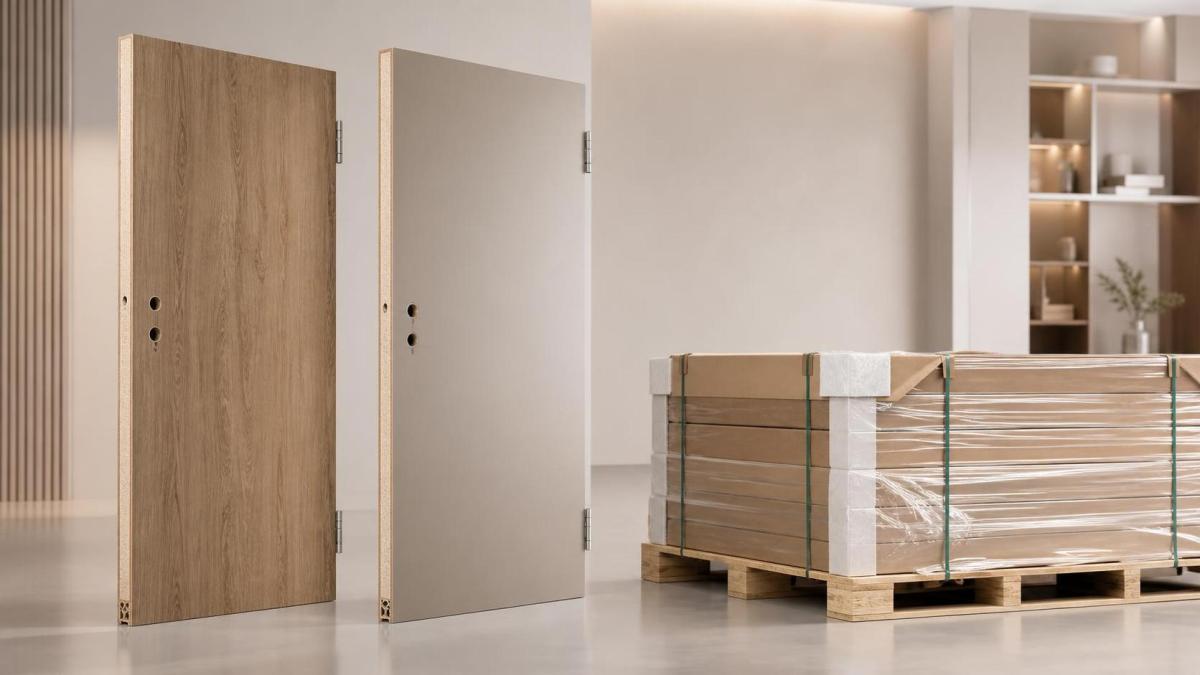
Packaging, damage prevention, and shipping format. Doors are bulky, finish-sensitive products. Even when freight rates are manageable, poor packaging can turn a reasonable purchase into an expensive claim file.
Buyers should ask for the packing method, loading plan, and product identification approach before placing the order. This is particularly important for mixed-size projects or site deliveries with phased installation. The cost of stronger corner protection, labeled bundles, or project-based packing may be justified if it reduces sorting errors and transit damage.
What should a procurement team request in the RFQ to get comparable pricing?
A vague RFQ produces vague prices. To compare Premium Europe Market PVC and MDF Wood offers properly, include the build details that actually change cost.
- Door type and application scene
- Size schedule and whether dimensions are standardized or fully customized
- Material stack, including MDF, HDF, plywood, solid wood, or composite elements
- Finish type: laminated, painted, wood grain, or RAL-based pure color
- Functional requirements such as fireproof, sound insulated, or moistureproof performance
- Required documents, including commercial and technical records relevant to the order
- Packing standard and destination market
When buyers leave those fields open, suppliers fill in the gaps differently, and the price comparison stops being useful.
Is the cheapest quote ever the right choice?
Sometimes, but only when the specification is truly aligned and the supplier has priced the same scope. In practice, the cheapest offer is often missing something: lower-grade core material, a simpler finish system, less protective packaging, or no allowance for project-specific details.
A better rule is to compare total acquisition cost. That means unit price plus documentation readiness, expected defect exposure, installation fit, and replacement risk. If the door program includes hospitality, school, apartment, or villa use, consistency tends to matter more than winning a small saving on paper.
The strongest buying position usually comes from a short sequence: lock the technical scope, narrow the finish and size variables, verify the production basis, then negotiate. Price becomes much easier to control once the quote is built on the same door, not just the same description.
Leave A Reply
Need More Details?
Contact me for details on creating and managing design projects, project features, and services and prices