


NEWS
Categories List
Bifold Glass Doors: How Panel Size and Hardware Affect Smooth Daily Operation
Bifold Glass Doors are often selected for the visual result: wider openings, more daylight, and a cleaner connection between a living room and a terrace, garden, or adjoining interior space. Yet the operating quality of a folding door is decided long before the first panel is moved. A door can look excellent at handover and still become difficult to fold a few months later if panel weight, frame stiffness, roller capacity, hinge geometry, and installation tolerances were not considered as one system.
For quality-control and safety work, the question is not simply whether the door opens. It is whether it opens with controlled force, remains aligned through repeated use, locks consistently, avoids finger-trap hazards, and continues to carry glazed panels safely when temperature changes, settlement, or ordinary wear introduce small movements. Folding systems are less forgiving than a simple hinged door because each panel affects the next one.
Panel Size Is a Load Decision, Not Only a Design Decision
Large glass panels create the broad, uninterrupted view that owners want, but larger panels also place more demand on every moving component. Their weight is influenced by glass build-up, panel width and height, aluminum profile design, reinforcement where used, and hardware. In practice, the risk is rarely one dramatic failure. More commonly, excess or poorly distributed load shows up as a panel that drags at the sill, a folding stack that does not park neatly, uneven reveal gaps, or a lock that needs to be lifted or pushed into position.
Wide panels can be particularly troublesome when the hardware was chosen by nominal panel count instead of actual sash weight. A four-panel arrangement is not automatically lighter-duty than a two-panel arrangement; the relevant issue is the weight carried by each roller, hinge, pivot, and fixing point. The glass specification matters here. For example, insulated glass constructions such as 5mm+12A+5mm or 6mm+12A+6mm should be assessed as part of the complete sash calculation, rather than treated as a late-stage glazing choice.
Panel proportion matters as well. A tall, narrow sash may have acceptable total weight but still be more prone to deflection or twisting when moved quickly. A very wide sash can feel stable when closed but impose high leverage on hinges and carrier assemblies during folding. There is no universal “safe” panel dimension that applies to every system. Quality teams should require the fabricator or system supplier to confirm the allowable sash size and sash mass for the selected hardware configuration.
The Hardware Chain Must Be Checked as a System
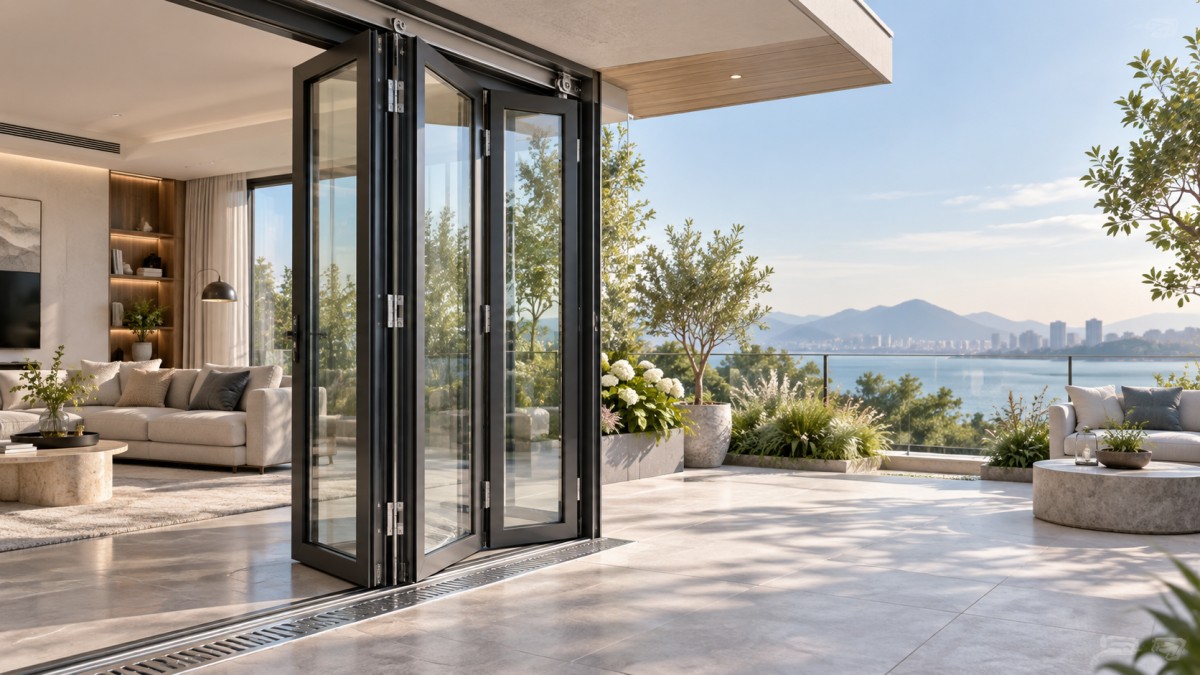
A bifold door’s movement depends on a chain: top or bottom carrier, track, guide, hinges, intermediate pivots, handles, locking points, and frame fixings. A high-quality roller cannot compensate for a distorted track. Strong hinges cannot solve a loose jamb. Likewise, a well-made aluminum profile will not maintain alignment if glass setting blocks are misplaced or if the sash is inadequately packed during assembly.
Roller selection deserves close attention because it is where operating force becomes most obvious to the user. The roller load rating should exceed the calculated load it will carry in the actual configuration, with the manufacturer’s stated limits checked for the particular arrangement. Inspect the wheel material, bearing condition, carrier fixing, and engagement with the track. Nylon-based components can provide quiet movement, but they still need to be appropriate for the expected load and environment. A smooth door that has only been tested once is not enough; repeated opening and closing reveals whether the system begins to bind.
Hinges are equally important. In a folding door, they do more than connect panels: they preserve the geometry that allows several leaves to move together. Hinge play, incorrect screw torque, incompatible fasteners, or poor screw retention in thin profile sections can gradually create sag. German-engineered hinges are often specified for precise movement and durability, but the practical inspection point remains the same: verify the actual hinge model, fixing method, load compatibility, and adjustment range rather than accepting a general hardware description.
Track Alignment Is Where Installation Errors Become Daily Friction
A folding door can leave the factory correctly assembled and still perform poorly after installation. The opening must be checked for level, plumb, and squareness before the frame is fixed. Even a small deviation can make a multi-panel system feel heavy because the carriers are constantly being pulled off their intended path. For outward-facing doors, threshold support and drainage are especially important: water, abrasive dirt, construction debris, and sealant residue can affect movement or obstruct drainage routes.
During acceptance inspection, operate the door from fully closed to fully stacked and back again. Do not only test the lead panel. Watch whether the intermediate panels fold in sequence, whether wheels remain seated, and whether the stack stops where intended. A slight resistance at one location may point to a local track problem, a hinge alignment issue, or glass-induced sash distortion. It should not be dismissed as normal “run-in” behavior without investigation.
Frame anchoring also deserves a practical review. Fastener location, substrate condition, shim placement, and perimeter sealing all influence long-term stability. Packing should support the frame without bowing it. Over-tightened frame fixings can distort aluminum sections; under-secured fixings can permit movement that later appears as lock misalignment. These faults may be hidden behind trims, so inspection records and installation photos are useful quality evidence.
Safety Checks Go Beyond Tempered Glass
Glass safety is essential, but it is only one part of the risk picture. The intended glass type should be verified against project requirements and applicable local rules, particularly where doors are installed in high-impact locations. For insulated glazing, edge seals, setting blocks, clearances, and bead engagement should also be checked. A panel can be made with suitable safety glass yet still be unsafe if the glazing is poorly seated or the sash is distorted.
Operational hazards often arise at the meeting edges between folding panels. Users naturally hold these areas while guiding the door, which makes finger protection and clear handling instructions relevant. Check that handles are secure, locking hardware engages without abnormal force, and the parked stack does not swing back unexpectedly. Where a multi-lock system is provided, every locking point should be tested with the panels in their normal closed position. A lock that engages only after pushing the sash upward is usually a symptom to correct, not a user technique to rely on.
Weather sealing should be judged alongside usability. EPDM gaskets and silicone-based sealing systems can help manage air and water paths, but overly compressed seals can increase closing force. The right balance is not achieved by making every seal tighter. It comes from accurate profile geometry, compatible seals, correct sash adjustment, and a threshold design suited to the exposure condition.
A Practical Inspection Routine
Before release or handover, a concise but disciplined check is more valuable than an attractive finish inspection alone. Review the following points while the door is clean and the site is accessible:
- Confirm panel count, opening direction, glass build-up, profile selection, and hardware against the approved configuration.
- Operate the complete system several times and note any scraping, clicking, sudden resistance, or inconsistent stacking.
- Check visible gaps around each sash, hinge security, carrier seating, track cleanliness, and lock engagement.
- Inspect the threshold for debris, blocked drainage, inadequate support, or signs that the frame has been distorted during fixing.
- Record adjustments made at installation, since repeated adjustment may indicate an underlying frame, sash, or hardware issue.
Routine maintenance should be simple: keep tracks clean, avoid aggressive lubricants unless recommended by the hardware supplier, and investigate changed operating force early. Waiting until a panel visibly sags can turn a minor adjustment into replacement of rollers, hinges, or damaged track sections.
For projects needing a coordinated aluminum-and-glass solution, Black Aluminum Glass Accordion Door with German Hinges Multi Lock System and Soundproof Glazing for Living Rooms illustrates the kind of configuration that should be reviewed as a complete assembly. Its available profile thicknesses range from 1.4mm to 3.0mm, while glazing and hardware should still be matched to the final panel dimensions, site exposure, and required operating load. A stated sound insulation value of 45 should also be verified for test method, units, and installed-system conditions before it is used in a project specification.
Manufacturing Detail Has a Direct Effect on Field Performance
In folding-door production, cutting accuracy, machining positions, assembly jigs, glazing practice, and final adjustment all affect performance on site. Weihai Gensheng Trading Co., Ltd. manufactures aluminum casement, folding, and sliding doors alongside wood, wood-aluminum, and related architectural products. Its use of German equipment and window-production software reflects a practical reality of this category: repeatable machining and accurate hardware preparation are not cosmetic improvements; they are the basis for panels that align and fold predictably.
The best inspection mindset is therefore cumulative. Confirm that the panel size suits the load path, that the hardware is rated and correctly fitted, that the frame is installed without distortion, and that the completed door works smoothly without force or improvisation. When those conditions are met together, Bifold Glass Doors are far more likely to retain their quiet, controlled movement in everyday use.
Leave A Reply
Need More Details?
Contact me for details on creating and managing design projects, project features, and services and prices